

Cloud Sneezing
The Book Room: Portraits of Women by Women.

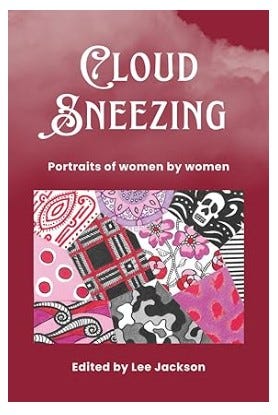
In the week following International Women’s Day, I have the great pleasure of inviting a group of women into The Book Room, with an anthology of stories and poems, Cloud Sneezing - Portraits of Women by Women
It was such a joy to receive this powerful anthology of short stories and poems from this group of talented writers. It is an important body of work, raw in places, gentle in others, that raises those voices so often silenced or buried, whether in history or in the communities of now: those of women.
Each story is a snapshot of a woman’s life, told with originality and emotional heft. Through their words, the authors touch on universal themes, those that have affected women across ages and continents, such as persecution, fear, and abuse. Still, it is also a celebration of all the positive and powerful traits that make a woman, a woman.
All the makings of excellent writing craft are to be found within these pages: clever characterisation, mystery, dramatic tension, punchy dialogue, humour and pathos, and a sense of place that puts us right there with the protagonists of the stories. You will be enthralled.
Cloud Sneezing – Portraits of Women by Women is a call to arms, a call to speak our truth, to stand proud and shout, ‘We are women, and these are our stories.’
But that’s enough from me. Let’s hand over to Charity, Rose, Heather, Michele, Aimee, Robin, Laura, Gaynor and Lee.

Sisters of Audacity
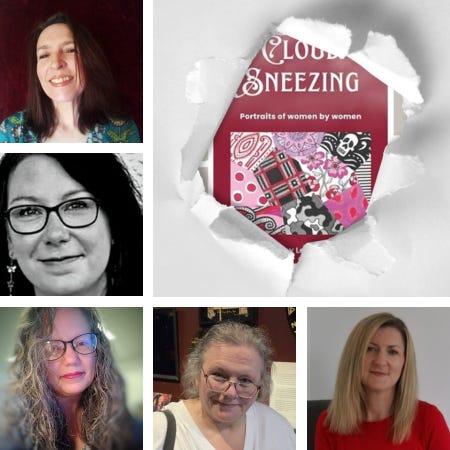
We call ourselves the Sisters of Audacity – a sort of jokey name we used for our WhatsApp group while we were writing it. We are actually Aimee McGowan, Charity Reed, Robin Montgomery-Smith, HEATHER GROSSART, Laura Scott, Michele Hinchliffe, and RoseCSmith writer .
What’s your book about?
Primarily, it’s about women. Not necessarily heroic women, or evil women, just women main characters, warts and all. There are themes of loss and judgement, particularly within the stories that cover witch trials, but it also has humour, childhood adventure, fantasy, sci-fi, and memoir. We even managed to slip a couple of poems in.
Where did the idea for your book come from?
We were all studying Creative Writing at either basic or advanced level with the Open University. In the spring of 2025 we were using the newly created A&H Student Common Room as a workshopping space, and realised we loved each other’s work, so we thought it would be a great idea to take it further.
What were your childhood experiences of reading and writing?
Charity: I grew up with a songwriter for a father, and a poet for a mother, so it really came as a natural part of life. I was told by a family friend that I used to make up stories about my dad tackling diamond thieves when I was around two years old, so I suppose I’ve always done it without realising. The first book I remember was The Hobbit, I could quote the audiobook before I could read.
Laura: I loved Roald Dahl’s Matilda and The Witches when I was younger, as well as the Narnia series by C.S. Lewis. I think Matilda is one of my favourites, these stories would inspire me as a child and gave me a character to resonate with. I love how they have been adapted for the screen and stage. I could relate to Matilda’s small and timid character (I also love the illustrations), yet she was clever, and I admired how she stood up to the adults around her. I was delighted when she discovered her magic powers, and at the time, I thought I might be able to move things with my eyes. I was slightly disappointed when it didn’t work.
Robin: My Grandma read books to me as long as I can remember and when I was old enough to read for myself, she let me read them back to her. She had a stroke when I was 16 and wasn’t able to read for herself anymore, so I would go next door after school and read books to her. I also used to make up stories to tell her like I was reading when I was a kid, before I could read properly. I’d hold a book in front of me (often upside down) and ‘read’ out loud. I’d even turn the book around to show my audience the pictures, like my Grandma did.
Heather: I loved books as a child. More than once I injured myself walking and reading at the same time. A teacher once told me I was a natural storyteller, I’m not sure that she meant writing, but I took it to mean that!
Aimee: My experiences began when I was very young. In Primary 2 we were asked to create a book about a monster. I kept my book in my nanny’s loft for years after, and still remember my cuddly, fluffy purple monster! In P3 we studied ancient Egypt, I spent hours upon hours reading and looking up information and my report ended up pages long. I knew then that when I found something I enjoyed, words just sprang into my mind. It wasn’t until P7 that I became interested in reading. We were introduced to the book by Teresa Breslin Divided City, it’s a book about Glasgow, and growing up with friends and family that supported both Rangers and Celtic, I began to read the book because it’s based on those. You’d be surprised how much you judge a book by its cover! After a few chapters I was hooked, and had to read on to find out what happened. Did things change? Were they allowed to be friends in the end? It really introduced me to compelling stories and characters you rooted for.
Tell us about your writing process and what you’ve learnt along the way
Charity: Despite having written stories and poetry for years, I’ve discovered, through both this process, and my uni courses, that I wasn’t as good as I thought I was! Rereading through old pieces, I’ve been absolutely embarrassed by my lack of skill, but delighted with my progress.
Laura: I am not much of a routine person or planner. Being a single mum, I’ve found I have to sit and write when I get a moment. And that can be difficult. Therefore, I have to make it happen. For example, if I’m thinking I’ll need to start making dinner in about an hour, rather than starting to do more housework, I’ll make sure I spend that hour writing or studying. I now have the mindset that it doesn’t matter if I have clothes hanging up and drying all around me. I can work with the untidiness and wait until later to put all the clothes away; I’ll get it done at some other point. At the moment, I’m finishing my degree, and I’m loving the Language and Creativity module. I’m fortunate to be working from home, so I take those moments to write whenever I can and whenever I have the energy to do so. Sometimes that’s when I get up in the morning, or it could be catching an hour or so before I go to bed. I used to find it difficult when I was trying to write, and I would get interrupted, but now I’m getting used to it. I deal with the problem, or put together the snack or meal, or make that phone call, and then I get straight back to writing or studying.
Robin: The biggest thing I’ve learned recently is that I need to be working on several projects at once. I am easily distracted and can be pulled away from a project. So, when I hit a wall with a WIP, I will put it away and work on something else. Eventually, I’ll go back to it. I’m currently working on a novel (historical fiction) and I work on it for a period of time and when I no longer am making sense, then I save my work and work on something else. This ‘discovery’ has helped me actually stay focused and I’m making great progress with the novel now!
Heather: The biggest problem I have is starting a story, I can’t seem to move on if I can’t get that right. I can ‘knock something up’ quite quickly once I get over the beginning.
Aimee: My writing process is a little unconventional. I tend to write down ideas or a few sentences starting the story, then stop. I find that in the days or weeks following, I begin to dream out the story lines or where I’d like them to go. I wake up and jot down the main points, but until I’ve slept on it, I can’t take a story very far. It’s really the basis for most of my ideas.
What was the hardest part?
Charity: Probably working with so many others. It’s been a democratic process throughout, but we all have very strong personalities and despite our best efforts we haven’t always agreed on everything. That said, it’s worth every disagreement to have met such a wonderful bunch of women, and it’s certainly not put me off future collaborations.
Laura: Juggling everything and reaching those deadlines. But I’ve also learned that I work better when I do have a deadline. I prioritise the writing first, rather than the housework. My son is getting a bit older now, so I ask him to help out at times. Although this can be as much effort as doing it yourself, it’s been worth it as I am beginning to get a bit more time to myself these days. Plus, I have got a lot better at asking for help these days and I make it clear to others that I need to get this done. I may have to miss that social event or not have a clean and perfect house for a while; things like that don’t bother me as much as they used to.
Robin: The hardest part of my current project (Cloud Sneezing) was waiting. I’m infamously impatient and want everything done five minutes ago, so waiting for the book to be released was the most difficult part.
Heather: The hardest part is the beginning of anything. But also trying to reign in the large ideas that I always seem to think up. Especially when the word count is 2,000.
Aimee: I find it hard to continue writing something if I’ve lost track. Sometimes I’ll begin with the idea, the character, and the exact map of where I want the story to go, but if I don’t feel connected to the character, I can’t find the right words or events to carry me along on their journey.
How was the journey to publication?
Charity: Easier than I expected. One of the amazing women, Heather, co-owns a small publishing company, Melius Scripto Press International so we just told her we’d love her forever if she convinced them to publish. Luckily, she was right behind the whole project and she’s a star.
Laura: The group of women that I was working with were amazing, and so supportive when writing and editing. Picking up points that I had missed, and my writing improved through all their help and advice. It would have been difficult to do it all on my own. I think you need at least one or two people to bounce off. Again, I’m getting better at asking for help and taking advice. The journey to publication can be a slow process. I was prepared for that, a lot of waiting for things to happen in between. Then all of a sudden, you would have a week to get work completed. But I’ve loved it and learned so much along the way.
Robin: It felt like it took an age, but it was actually much quicker than I thought it might be. We didn’t really start planning until May 2025, so although there was a bit of a stall when we were waiting for everyone to decide on what stories they were going to submit and to agree (or not) on the title, it was relatively quick. There’s a lot out of the control of the writer, so letting that control go was a challenge. But I’m very happy with the result and I’m pleased with the finished project.
Heather: I own the publishing company that published Cloud Sneezing. Melius Scripto Press was founded to help new/novice writers have somewhere to go where they would be supported. Though I would say the writers for Cloud Sneezing are all great writers and didn’t need supporting. They will all have great writing futures.
Aimee: I was very lucky in this. The group of women I write with had this organised between them when they asked me to be part of their anthology. I found it fascinating listening to their ideas and what was needed to get to the final stages. I put in a lot of effort – but I was lucky beyond words that I shared the burden with the most amazing women, who helped keep me on track and explain what I wasn’t sure of. I relied on their knowledge and advice.
How about marketing, any top tips?
Charity: Get someone else to do it – only joking but I have found this to be the hardest part about the process. Social media doesn’t come naturally to me, so I’ve had to learn a lot. I’ve connected to other authors (also a trove of amazing writing to read as a bonus) and set up a Substack, Instagram, Facebook, and posted about the book on LinkedIn too – but it isn’t my comfort zone.
Robin: Get a press kit (there’s loads of ideas online) and get some really snazzy photos of the book, once you’ve received your copy. Word-of-mouth is a great way to advertise, but that’ll only get you so far. You must be prepared to do the work because actually getting the book published is the easy part. The hard part is getting it out there so people can read it. But no one will read it if they don’t know about it. Getting it reviewed and in the hands of readers is the first big step after publication, especially once the glitter wears off of the launch.
Heather: Marketing is where the ‘hard work’ starts. Social media is where you have to be… all platforms.
Aimee: A friend told me to never be shy about creating something incredible. Put yourself out there and never apologise for your efforts. I think this is a huge thing that happens, particularly in Scotland, as we tend to put ourselves down a lot. Having the courage to tell people what you’ve done and sharing your work is daunting, but necessary.
What would you say to someone starting their writing journey?
Charity: Just write! Getting published is fantastic, but writing is the main pleasure for me. It’s cathartic, and even if nobody ever reads it, you will. If you do want to be published, start by sending your work to publications, you’ll get a feel for what’s wanted out there. Also, get a group of writer friends, workshopping is absolutely invaluable.
Laura: Write like no one is going to read it. I pour my heart onto the page and edit later. I was inspired by my auntie, who sadly passed away in December from cancer. She self-published, and after she read some of my work, she encouraged me to publish too. Just write, she would say to me. At times, I would think, why am I bothering. But I’m glad I stuck with it. Just keep going, even if you only manage to write for 20-30minutes. You’ll look back on it one day and realise how far you have come.
Robin: Write what you want to write - you’ll find your audience. But make sure you have a story that people want to read. Read a LOT. Good writers are always readers. Devour as many books as you can, especially in your genre. Avoid tropes (or at least turn them on their heads). And above everything - don’t ever give up. It’s never too late to go after the dream of writing and publishing a book.
Heather: Don’t give up and keep writing!!
Aimee: Experiment. A lot. Find what works for you. It could be something ridiculous like only writing in the bath, with no phone, so there are no distractions. Obsess over your characters, talk to them, make them real in your mind. It might be something straightforward that works for you, like plan, plan, plan. It might be something totally irrational. Everyone’s different and has their own quirks. Go with them.
Where can we buy your book and follow you?
The Cloud Sneezing website has all our links, bios, info etc.
Amazon.co.uk Bookshop.org Abebooks.co.uk Waterstones.com Bookwagon.com
This was such an interesting read for me as I'm currently discussing with one of my writing groups whether it would be possible for us to create an anthology of the stories. This shows it can be done. I will add this to my reading list. 🙏🏼
I started my writing journey with the OU. Creative Writing was a brand new module back in 2006, it looks like it’s developed immensely since then. How wonderful to be involved in something like this. Ordered my copy of Cloud Sneezing ☺️